What is tzedakah, and why Judaism frames giving as obligation
What is tzedakah? A plain explainer of the Jewish duty of righteous giving, the meaning of the word, Chai gifts in multiples of 18, and how synagogues collect it.
Last updated July 2026 by Fatih
Quick answer
Tzedakah is the Jewish obligation to give to people in need. The word comes from tzedek, the Hebrew root for justice, so giving is treated as a duty owed to others rather than optional kindness. Many Jews give in multiples of 18, the numerical value of chai (life), such as $18, $36, or $180. Synagogues collect tzedakah in person and online.
Key takeaways
- Maimonides ranked forms of tzedakah, placing helping someone become self-supporting at the top.
- Synagogue kiosks see most use at weekday minyan and Hebrew school drop-off, since members do not handle money on Shabbat.
- Givebear kiosks can show chai amounts such as $18, $36, and $180 as preset buttons.
Who this is for: Synagogue administrators and treasurers who manage a tzedakah fund and need to explain giving to members; Rabbis, educators, and B'nei Mitzvah teachers introducing the concept of righteous giving; Lay leaders and board members planning an appeal, building campaign, or High Holiday giving drive; Members and families who want to understand what tzedakah is before setting up a recurring gift
Tzedakah (Hebrew: tz'dakah) is often translated as charity, but the root tzedek means justice or righteousness. That distinction matters: in Jewish thought, giving to those in need is not an optional act of generosity prompted by a warm feeling, it is an obligation owed because the world is meant to be ordered justly. A person of means is expected to give whether or not they feel moved to, because the recipient has a rightful claim on a portion of what flows through the community.
Practice varies across Orthodox, Conservative, Reform, Reconstructionist, and unaffiliated Jewish life, and nothing here is a halachic ruling; ask your rabbi about your own obligation. What is shared across movements is the idea that giving is owed, the habit of giving in multiples of 18, and the expectation that a gift designated for one purpose is used for that purpose.
Tzedakah means justice, not just generosity
The English word charity comes from the Latin caritas, meaning love or affection, which frames giving as something you do because you care. Tzedakah carries a different weight. Its root, tzedek, means justice or righteousness, so the act is understood as setting right something that is owed. The classical sources treat a portion of one's resources as belonging, in a sense, to those who lack, which is why the obligation holds even when the giver would rather not.
Jewish tradition also speaks about how one gives, not only how much. The medieval scholar Maimonides described a ladder of giving with eight levels, where anonymous gifts rank higher than public ones and the very highest rung is helping someone become self-supporting. The practical takeaway for a congregation is that dignity and consistency matter as much as the dollar amount, which shapes how thoughtful synagogues design their appeals.
Chai giving and the symbolism of 18
In Hebrew, letters double as numbers, and the word chai (life) has a numeric value of 18. Because of this, many Jews give in multiples of 18 as a way of attaching a blessing for life to a gift: 18, 36 (double chai), 180, 360, or larger. You will see these amounts at weddings, B'nei Mitzvah, and memorial occasions, and they are a natural fit for synagogue giving.
Offering preset Chai amounts removes friction and signals that the congregation understands the tradition. Givebear lets you configure preset gift buttons on both the lobby kiosk and the website widget, so a guest at a Bar or Bat Mitzvah can give 36 or 180 with a single tap rather than typing a figure that carries no meaning.
How do synagogues collect and track tzedakah?
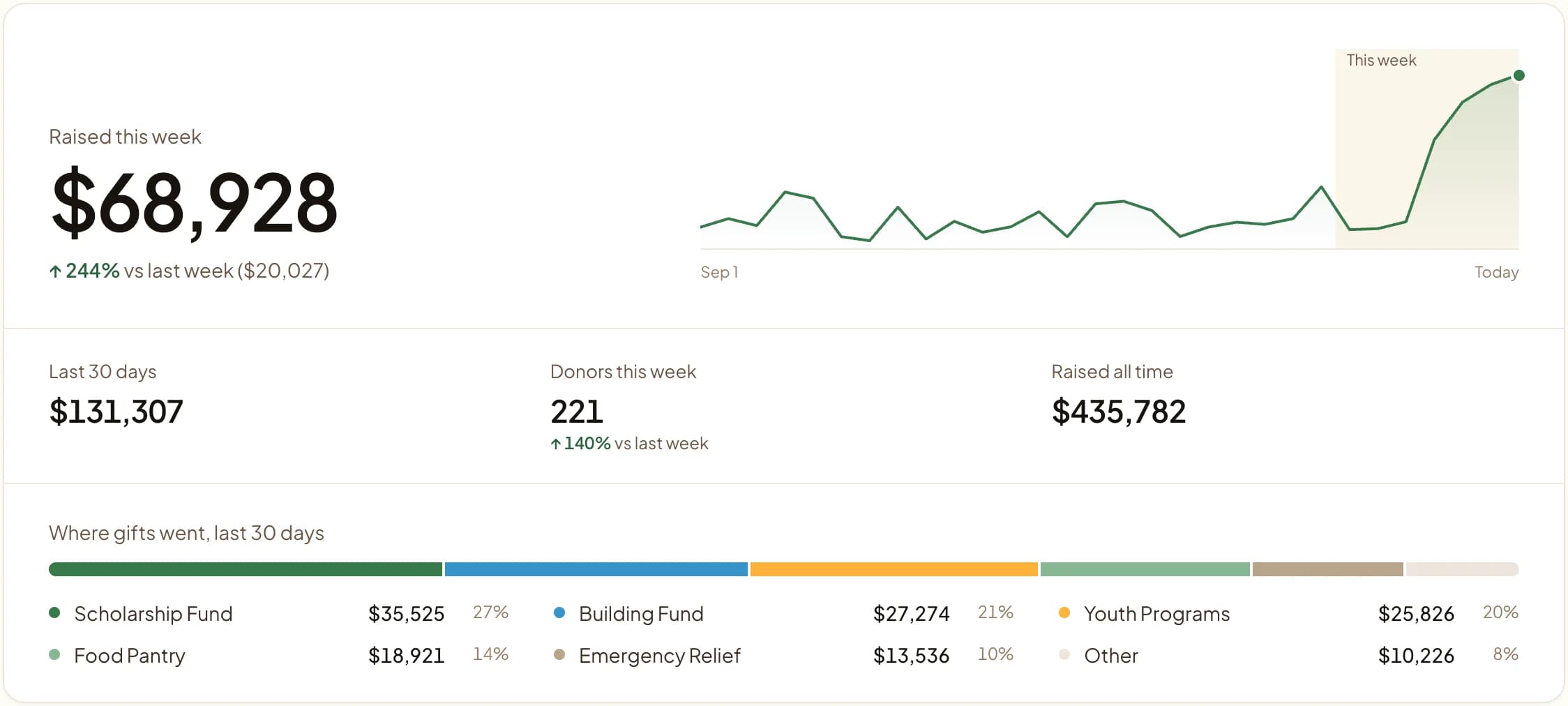
Most congregations maintain a general tzedakah fund alongside restricted funds for specific purposes: a building campaign, social action and tikkun olam projects, a cemetery or chevra kadisha fund, or a rabbi's discretionary fund. Keeping these separate is both a stewardship expectation and, for restricted gifts, a record-keeping requirement, since a donor who designates a gift expects it to be used as designated.
Givebear handles this with fund routing, so a single donation flow can direct gifts to the right fund while keeping the accounting clean. Pair that with recurring giving for members who pledge monthly, an emailed receipt for every gift, and one giving history per household for year-end statements.
Practical use cases
- Onboarding new members with a clear explanation of why giving is framed as obligation, not optional charity
- Running a High Holiday or Yom Kippur appeal where members pledge recurring tzedakah
- Letting B'nei Mitzvah families and guests give Chai gifts in multiples of 18 at a lobby kiosk
- Separating restricted gifts (building fund, cemetery, social action) from the general tzedakah fund
Key features
- A lobby kiosk for walk-up gifts, with Chai amounts as preset buttons
- A giving form on the congregation website with the same preset amounts (18, 36, 180, 360)
- Recurring giving so members can pledge weekly, monthly, or annual tzedakah without re-entering details
- Fund routing that tracks restricted gifts (building, social action, cemetery) separately from the general fund
- Email receipts for every gift and one giving history per household
Common questions
What is tzedakah in simple terms?
Is tzedakah the same as charity?
Why do Jews give in multiples of 18?
How can a synagogue collect tzedakah online and in person?
Does this page give a religious ruling on how much tzedakah to give?
More in Glossary
See it with your own funds.
Book a 30-minute walkthrough. No slides and no hard sell: we set Givebear up around how your organization already gives.
- Your funds, set up the way your treasurer reports them
- Where a kiosk would go, and what it costs
- The reports your board will actually see
Rather set it up yourself? Start free
Loading available times
Or open the booking page