Building fund campaign template: pledges, phases, and restricted funds
A capital campaign playbook for mosques and churches: structuring the quiet and public phases, taking multi-year pledges, keeping the building fund legally restricted, and sustaining momentum across years.
The goal
Fund a building project through a quiet phase, a public launch, and pledges paid over about three years, with every dollar held in a restricted fund.
Where Givebear fits
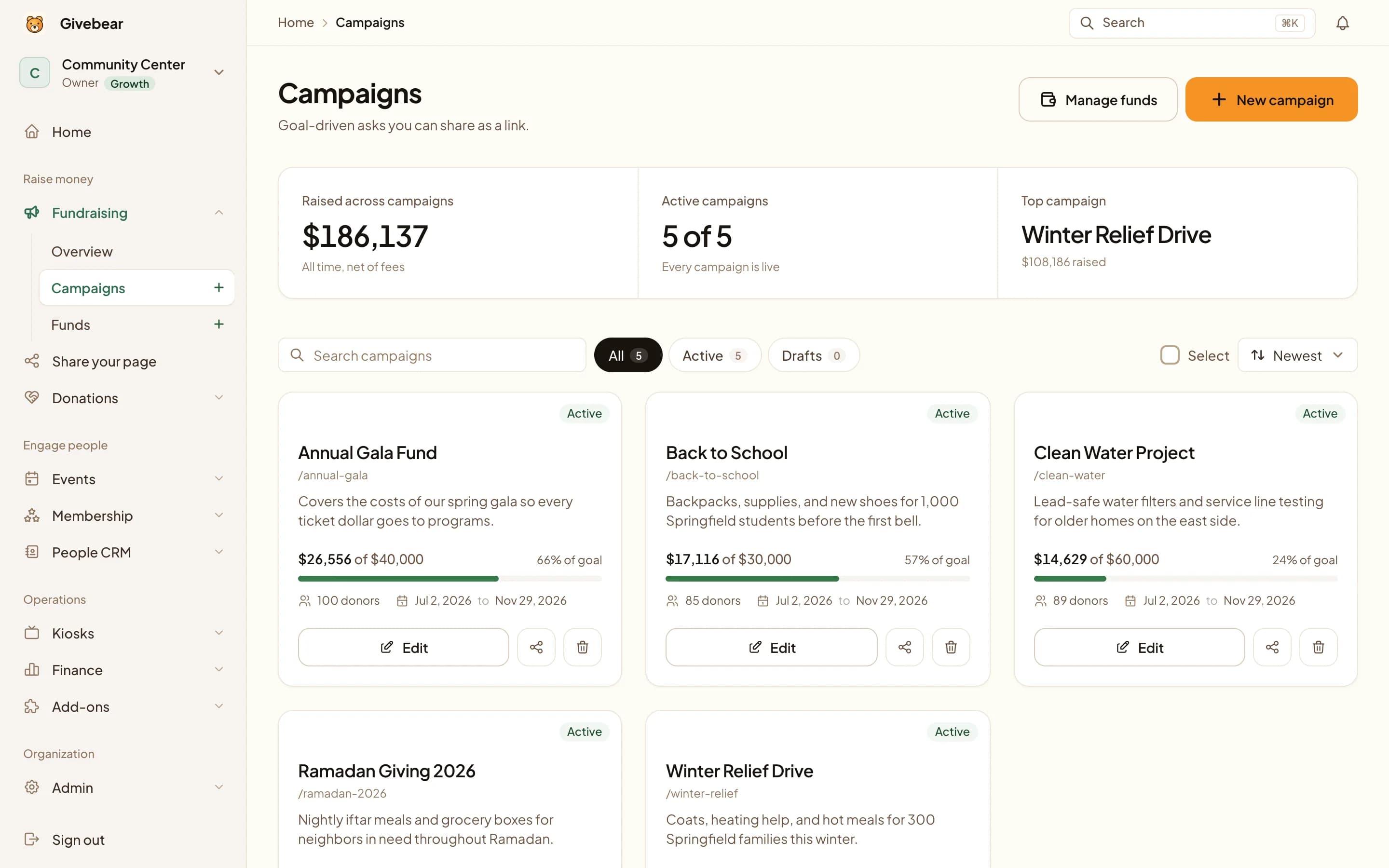
A restricted building fund on the website and the lobby kiosk, a progress bar on the campaign page, and monthly recurring gifts families can use to pay their pledges.
What it leaves to you
Givebear does not track pledge commitments. Record pledges in your own sheet or CRM, and use recurring gifts to collect them.
The plan, phase by phase.
Tick tasks off as you go. Your checklist is saved in this browser, and it works whichever giving platform you use.
Quiet phase
6 to 12 months before launch
Secure lead gifts privately before any public number.
Public launch
Launch weekend
Show the progress already made and ask everyone to join.
Pledge years
Every quarter until the building opens
Keep attention and payments going after launch.
Copy and adapt.
Replace the bracketed details with your own goal, fund and giving link.
Where to send it
- Campaign page
- Pledge cards
- Progress updates
- Lobby kiosk
- Board outreach
Launch email
Subject: [project] starts now We have already committed [amount] of the [goal] needed for [project]. Now we are asking every family to take part. Give once, or set up a monthly gift toward your pledge, here: [giving link] [name], [organization]
Thank-you message
Thank you for your gift to the [project] fund. It is held in a restricted fund and will be used only for [project]. We will share progress each quarter until the doors open.
Why this plan works
A building campaign is unlike every other appeal an organization runs: the goal is ten to a hundred times the annual fund, the timeline spans years, and the money is legally restricted to its purpose from the first dollar. Congregations that treat it like a bigger version of the weekly collection discover the hard parts late: pledges nobody tracked, restricted money that blurred into operations, and a campaign that went quiet in year two.
The usual capital campaign structure has three parts: a quiet phase that secures the lead gifts before any public announcement, a public phase launched with a third or more of the goal already committed, and pledges that let families give a larger amount over three years instead of only what they can give today.
This template applies it to a mosque or church: a restricted building fund from the first gift, pledges paid as scheduled recurring gifts, a building fund button on the lobby kiosk, and a progress thermometer the congregation can follow.
Quiet phase first: why you announce at 30%, not zero
Public campaigns that launch at zero stall at the hardest psychological point: nobody wants their gift to be the lonely first brick. The quiet phase fixes this. Before any announcement, the committee personally approaches the families most capable of lead gifts: typically securing 30 to 50% of the goal across a small number of major pledges. These conversations are face to face, specific ('we're asking you to consider $50,000 over three years'), and unhurried.
The public launch then opens with momentum already visible: 'we've raised $400,000 of our $1.2 million goal' transforms the ask from 'help us start' to 'help us finish.' For a congregation, the launch moment itself matters: a dedicated dinner or a Jumuah/Sunday announcement with the architectural renderings visible turns the project from an abstraction into a place their children will use.
Pledges over three years beat checks today
A family that can write a $2,000 check today can often commit $10,000 over three years, which is why pledges carry most capital campaigns. The traditional failure mode is tracking: pledge cards collected at the dinner, transcribed into a spreadsheet, and reconciled by hand against years of incoming checks, with awkward reminder calls when fulfillment slips.
Scheduled recurring gifts replace that machinery. The family sets up a monthly gift of about $280 to the building fund that stops after 36 payments; billing runs on its own, their giving history shows how much is paid, and the treasurer's pledge report is a filter rather than a reconciliation. Donors who prefer annual checks can still pledge that way: the point is that automatic fulfillment becomes the default, not the exception.
Restricted means restricted: the treasurer's burden
Money given to a building fund is legally restricted to that purpose. Spending it on operations, even as a 'temporary loan' during a tight month, creates liability for the board and a trust problem far more expensive than the cash-flow gap it papered over. The protection is structural: a dedicated fund whose balance is tracked separately from the moment of each gift, on every channel, with receipts that name the fund.
This is also what donors are watching for. A congregation asked for a multi-year commitment wants evidence the money is handled distinctly: a separate fund total reported at the annual meeting, receipts that say 'Building Fund,' and a thermometer that moves only with building gifts. Clean fund separation isn't just compliance; it's the campaign's credibility.
How do you sustain the campaign after launch energy fades?
Years two and three run on visible progress and rhythm, once year one's launch excitement fades: a thermometer update at every congregational gathering, a building fund button that's simply always on the lobby kiosk and giving page, and milestone celebrations (land purchased, permits approved, foundation poured) that re-energize giving at each stage.
Ramadan and year-end deserve their own building pushes within the campaign: a goal such as finishing the second floor gives the season's giving a concrete target. Keep collecting every week in ordinary time and push hard in the peak seasons.
Practical use cases
- Create a restricted building fund that's separate from operations from the first gift, visible on every giving channel.
- Take three-year pledges fulfilled through scheduled monthly gifts that bill automatically.
- Add a building fund button to the lobby kiosk so the campaign collects every single week, not just at events.
- Display a live campaign thermometer at fundraising dinners and on the campaign page.
Common questions
How much should we raise before announcing a building campaign?
How do multi-year building pledges work?
Can building fund money be used for operations temporarily?
Should the building fund be on our donation kiosk?
See it with your own funds.
Book a 30-minute walkthrough. No slides and no hard sell: we set Givebear up around how your organization already gives.
- Your funds, set up the way your treasurer reports them
- Where a kiosk would go, and what it costs
- The reports your board will actually see
Rather set it up yourself? Start free
Loading available times
Or open the booking page